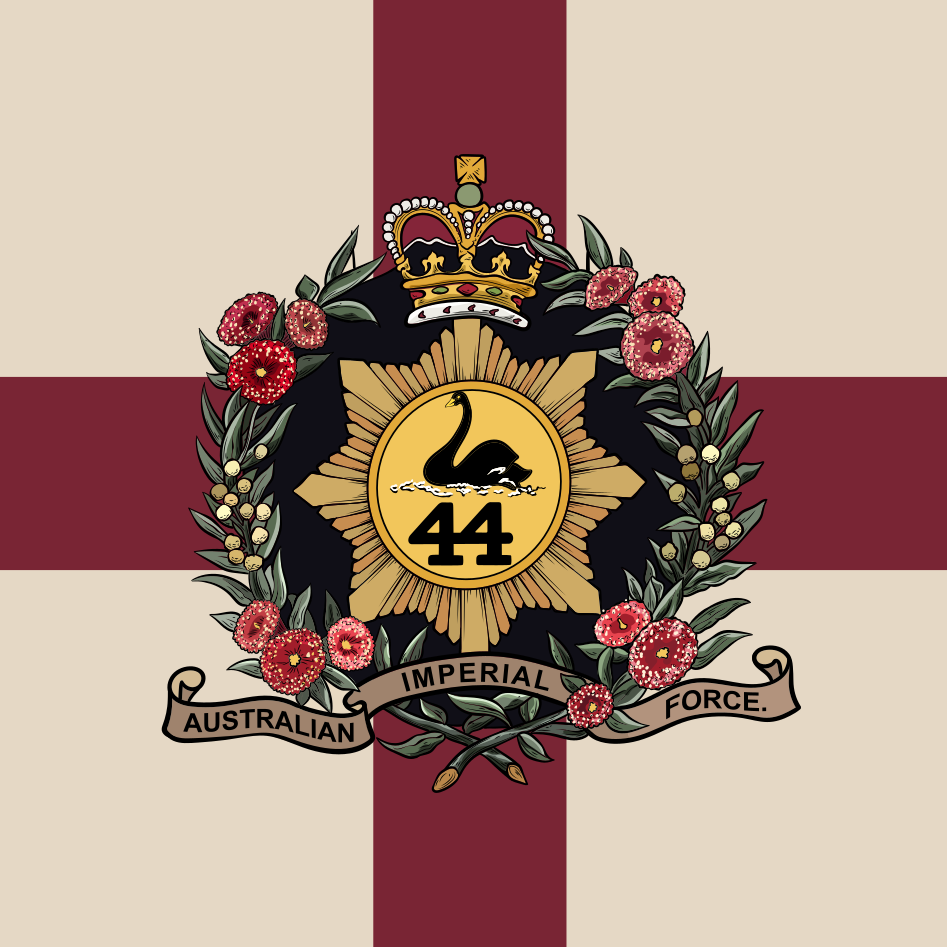

Smith, PTE Francis John
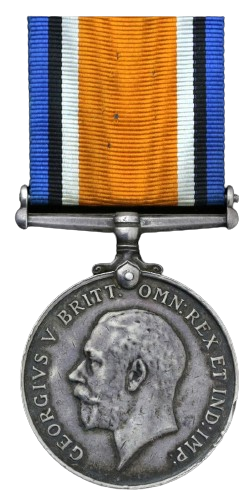
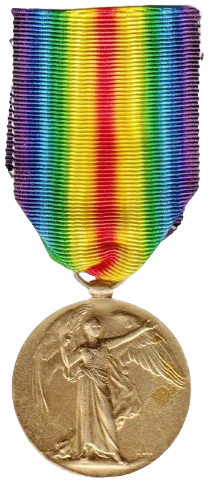
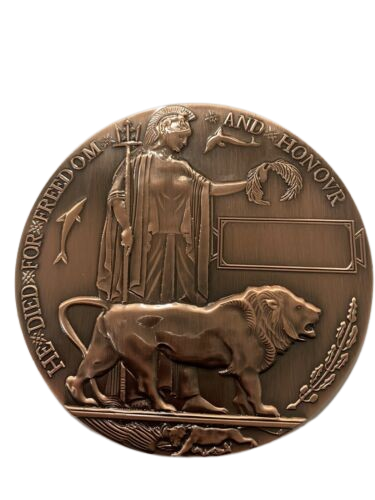
Francis John Smith nicknamed Jack (1882-1918), soldier and stockman, was born in Greenough, WA, son of Francis and Jane SMITH. His father had been born in Fremantle whilst his mother was born in England. Jack was a third-generation resident of Greenough. He had two older brothers (William and Ernest) and one younger brother and sister (Thomas and Amy). In his early years, the family lived between Greenough and Geraldton in the Mid West of WA. Tragedy struck when Jack was just six years old, as his mother Jane died at the age of 38.
Jack’s father soon married Margaret McClure and together they had another four children (Frank, Alfred, Jean and David). Upon reaching adulthood, Jack moved away from the family but remained in the Mid West region, eventually working as a stockman in the town of Mullewa. At the outbreak of the war, Jack was in his early 30s and unmarried. He tried to enlist early on in the war but was rejected due to having a speech impediment. He later tried again and was successful.
Francis John Smith enlisted into the Australian Imperial Force on the 26th of February 1917 at the age of 34. Two of his brothers, Ernest (10th Light Horse Regiment) and Frank (51st Infantry Battalion) had already gone overseas. He was originally assigned to also join the 51st Battalion and departed for overseas service aboard the HMAT Borda on the 29th of June 1917. Upon arriving in England, Private Smith was hurriedly assigned to the 44th Battalion to replace the losses suffered during the Battle of Passchendaele and he arrived in France on the 5th of December 1917. Here he would have learned of his brother, Captain Frank Smith MC’s death having been killed in October.
Private Smith’s first few months of service were relatively quiet in the Le Bizet sector. From March-April 1918, he fought desperately against the advancing Germans at Sailly-Le-Sac during the German Spring Offensive. In July 1918, he fought at Hamel and from August-September 1918, was in constant battles against the enemy at Amiens, Albert and St. Quentin Canal.
On the 29th of September 1918, Private Smith took part in the final battle of his battalion, the Breaching of the Hindenburg Line at St. Quentin Canal. On the first day of the battle, whilst advancing against the enemy, Private Smith was shot in the stomach by a machine gun and received a blast wound to the abdomen via a shell. Stretcher-Bearers Reed and Colhoun rescued him and took him to the British 50th Casualty Clearing Station. They immediately began operating on him, however Private Smith died at 7.15 a.m. on the 2nd of October 1918, living long enough to learn that the battle had resulted in a victory. He was buried at Tincourt New British Cemetery.
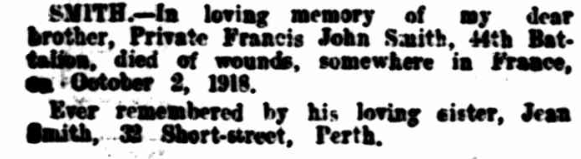
Jack’s half-sister Jean left a note in The West Australian in honour of his sacrifice one year after the war. Jack’s full estate of 101 pounds (Roughly $7,600 AUD in 2024 value) was given to his father.
National Archives of Australia: Series B2455, Item 1773749, P. 1-63
Australian War Memorial:
1DRL/0428 (Australian Red Cross Society Wounded and Missing Enquiry Bureau files, 1914-18 War. P. 1-7
Roll of Honour Circular: AWM145 Francis John Smith
Find A Grave: 56573132
Honour Avenues Group Kings Park: Francis John Smith
The West Australian: 2/10/19 P.1
AIF Project: Francis John Smith
Record worked on by: Luca Muir Anderson.
Record completed by: Luca Muir Anderson.