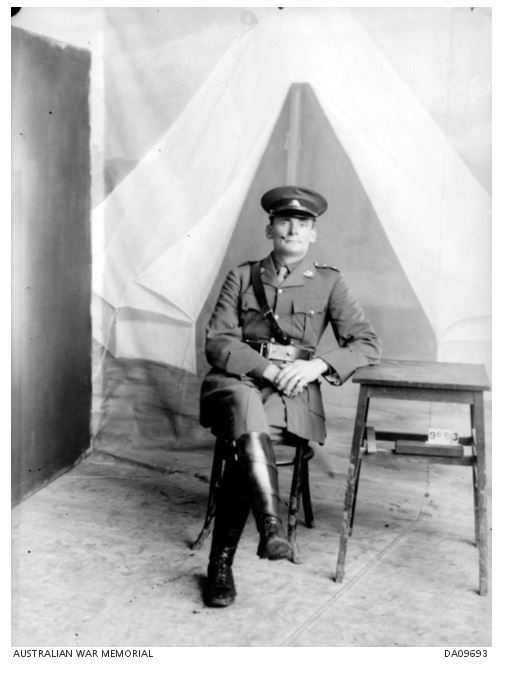
Captain Edgar Copley Adams MID (1882-1968), stationmaster and military officer, was born in the rural town of Laura, South Australia, son of John and Epenetus ADAMS. As a young man he moved to Mundijong, WA and worked at the local railway being promoted from railway porter in 1903 to night officer by 1906. It was here that he met and married Edith Annie Rowlett in 1906 at her father’s home and together they had a son, Edgar Mervyn ADAMS the following year.
In 1910 the family moved to Brunswick Junction where Edgar was appointed Night Station Master, however they quickly moved to Kamballie in the Goldfields, where he was promoted to Station Master. Here, he enlisted as a Private in the 84th Infantry Battalion (Army Reserves) in 1910/1911 and served as such until being commissioned as a Lieutenant in late 1911 and appointed to instruct the local 84th Senior Cadet Battalion. The family was well liked in the community and held social events.
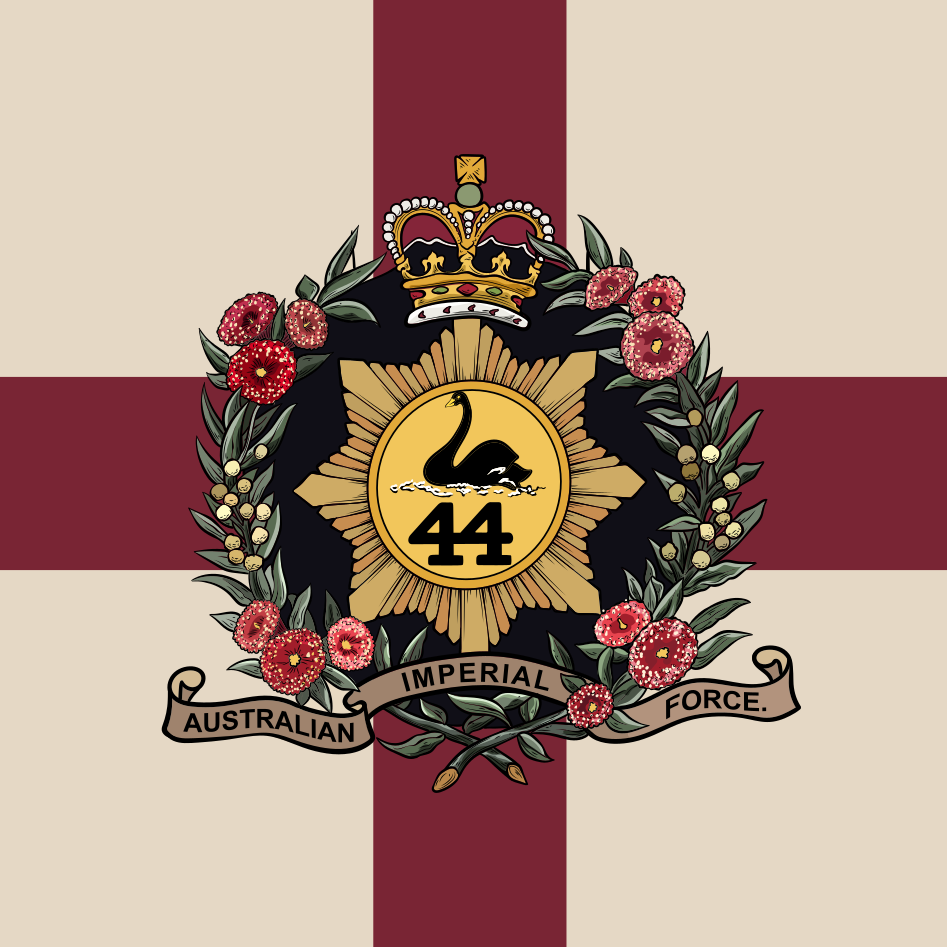
With the outbreak of World War One, Edgar remained a Lieutenant with the 84th Infantry Battalion until early 1916. By this time, the family moved to Hamersley Road, Subiaco and Edgar was made the Subiaco Station Master. On the 7th of March 1916, Edgar Copley ADAMS commissioned into the Australian Imperial Force and was quickly assigned to be the Signals Lieutenant of the 44th Battalion AIF.
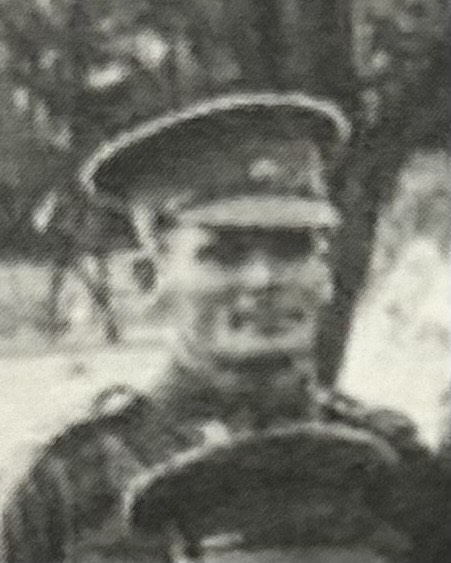
LT ADAMS in 1916
LT ADAMS embarked for overseas service on the 6th of June 1916 and arrived in Plymouth, England on the 21st of July 1916. Upon arrival in England, he spent six weeks studying at the School of Instruction and returned to his unit in the middle of September. On the 25th of November 1916, LT ADAMS arrived in France along with the rest of his Battalion and begin operations at the Armentieres Sector.
On the 30th of March 1917, LT ADAMS was Mentioned in Despatches by Major General John Monash, General Officer Commanding the 3rd Division:
“At Ploegsteert on the 30th of March 1917, the enemy severely bombarded Fort Boyd with high explosives. During the bombardment a bomb store in the fort was set on fire. Lieutenant ADAMS realising the serious danger that was imminent, at once went to the bomb store, in spite of the fact that a number of smoke bombs were already alight and several mills grenades had exploded and succeeded in moving many cases of bombs to a place of safety. He scattered the remaining loose bombs and covered them with sand which happened to be there in bags. His prompt action and coolness in acting in the manner in which he did, not only saved the majority of the bombs, but averted what might have been a serious loss of life. He set a fine example of courage and devotion to duty.”
As a result of this action, LT ADAMS was immediately promoted to Captain and given command of D Company. CAPT ADAMS continued to see service throughout the middle of 1917 at Messines and Warneton but was suffered briefly from Debility. He fought in the early stages of the Battle of Passchendaele but had to spend two months in hospital due to Syphilis, only recovering in December.
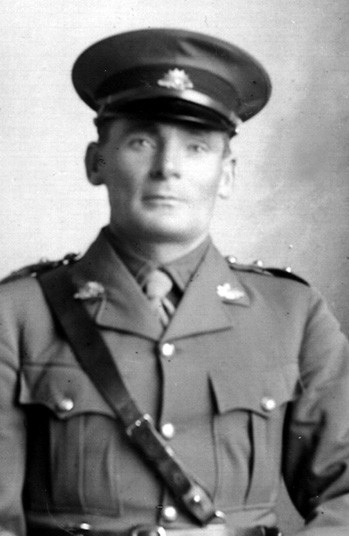
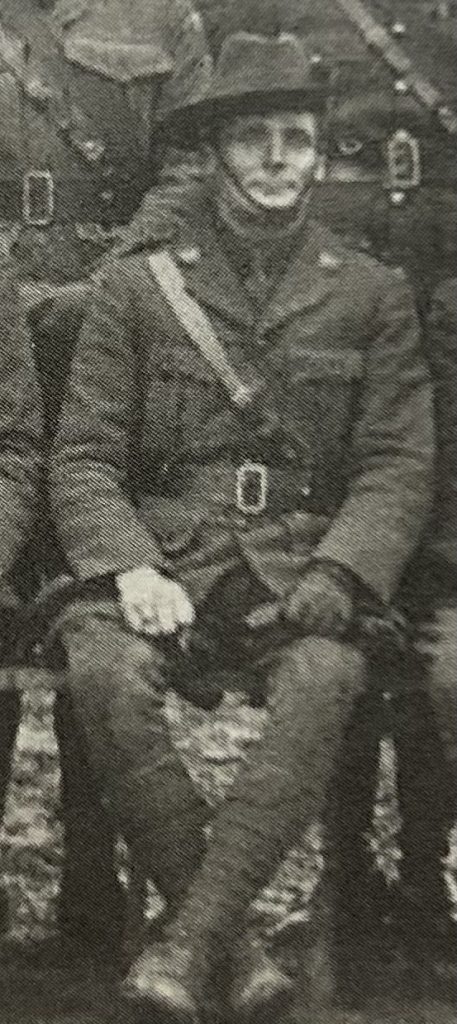
CAPT ADAMS in January 1918
CAPT ADAMS fought at the Somme during the German Spring Offensive of March-May 1918. During this offensive, the famous German fighter pilot, Manfred Von Richthofen (known as the Red Baron), was shot down over the 44th Battalion lines. The men immediately began pillaging the famous aircraft and CAPT ADAMS was one of the first officers to arrive and restore order as it was feared that so many soldiers in the open would result in enemy shelling. CAPT ADAMS was ordered by LT FRASER (the 11th Brigade Intelligence Officer) to place a guard around the downed aeroplane. CAPT ADAMS returned to D Company in early May 1918 after a period with A Company and was wounded in action on the 27th of May 1918 near Villers-Bretonneux but remained on duty.
He was then granted two weeks leave in England during June before returning to the line on the 24th of June. His final engagement came in early July 1918 at the successful Battle of Hamel. During the battle he commanded D Company, directing bombing teams and Lewis gunners against the enemy. During a reorganisation of his company, he personally sighted his Lewis guns and ordered the use of four captured German machine guns (Maschinengewehr 08). The following morning on his own initiative, he organised a raiding party alongside A Company to attack the enemy positions. This operation led to the disintegration of German forces in his immediate sector and the capture of 10 enemy machine guns, however multiple casualties were sustained. For his actions during the battle, he was recommended for an award but received none.
At the end of July, he was posted to instruct with the 9th Training Battalion in England where he remained until after the end of the war. CAPT ADAMS left England in February 1919, arrived in WA in April and discharged from the AIF on the 26th of May 1919.
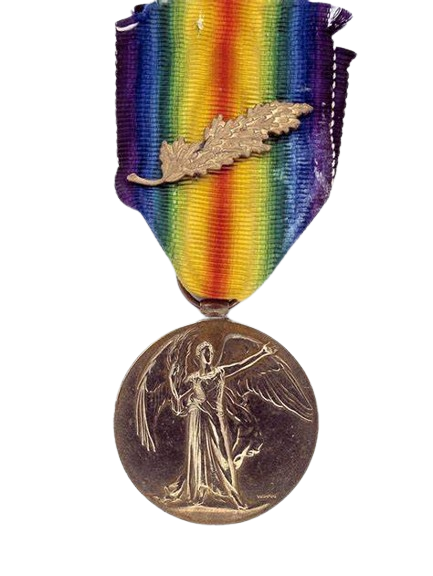
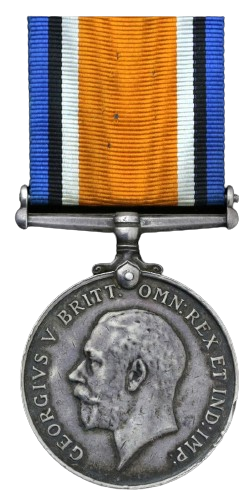
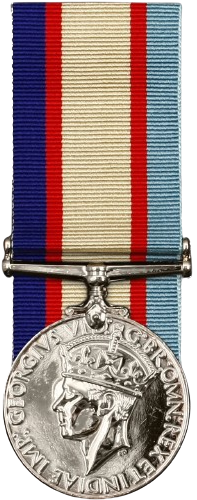
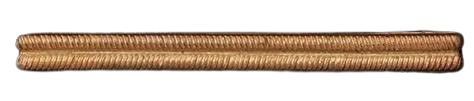
During the war, CAPT ADAMS fought in 9 battles and spent 526 days at the front line. He was awarded the Mentioned in Despatches, British War Medal, Victory Medal w/ Oak Leaf Device, Wound Stripe, Two Good Conduct Stripes, Two Long Service Stripes and the Active Service Badge.
After the war, Edgar and his family moved to Armadale where he became the Station Master and continued as a reservist officer for a short period in 1920, instructing the Senior Cadets. In October 1920, his second son was born. Tragedy struck in January 1921 when his first son, Mervyn died at age 11 when he crashed his bicycle into a horse-drawn cart. Mervyn had been riding on the wrong side of the road with his head down and could not steer out of the way in time as his bicycle skidded in the sand. The collision knocked him unconscious, but he was revived by bystanders who poured brandy down his throat. The bystanders then took him to the local hotel and informed Edgar. Edgar rushed to the hotel with a doctor from Victoria Park with his son’s final words being “Daddy, I’m Sick”. Mervyn died half an hour after the doctor’s arrival. Mervyn had been a member of WA Boy Scout Troop 65 (Armadale), who escorted him at his funeral.
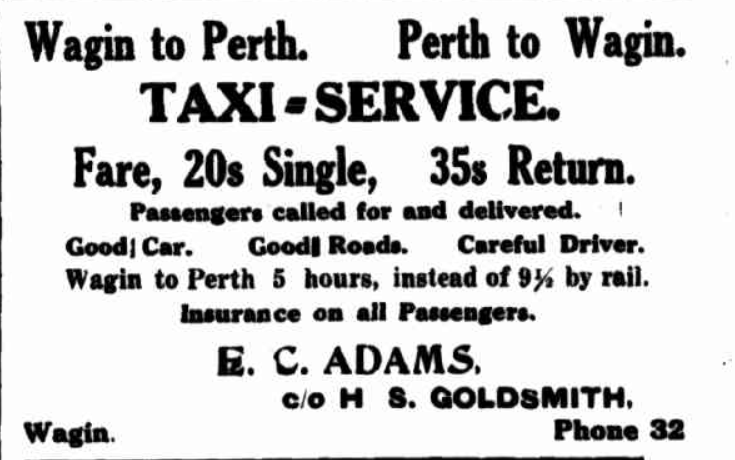
During the 1920s, the family moved to Burswood where Edgar was made the Station Master until he was dismissed from the railway department in 1928. The family then moved to Wagin where he made money by driving people to and from Wagin. This was a journey of 5 hours instead of the 9 hours by rail, he left Wagin at the end of 1930 for good. Around this time, relations with his wife became strained to a point that she requested a divorce in June 1931 which was accepted by the courts in November 1931. It had been alleged that Edgar had been unfaithful with a woman named Bertha Rowatt of Wagin who was the wife of one of Edgar’s wife’s brothers. After the divorce, Edgar moved to North Perth and was temporarily unemployed, a bad situation made worse by the onset of the Great Depression.
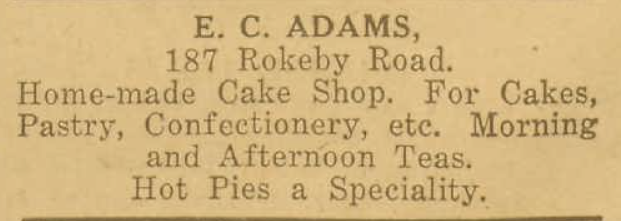
By 1934, Edgar was once again living in Subiaco and operated a home-made cake shop at 187 Rokeby Road. He continued to operate this cake shop until at least 1937. By 1939 he was living in Nedlands.
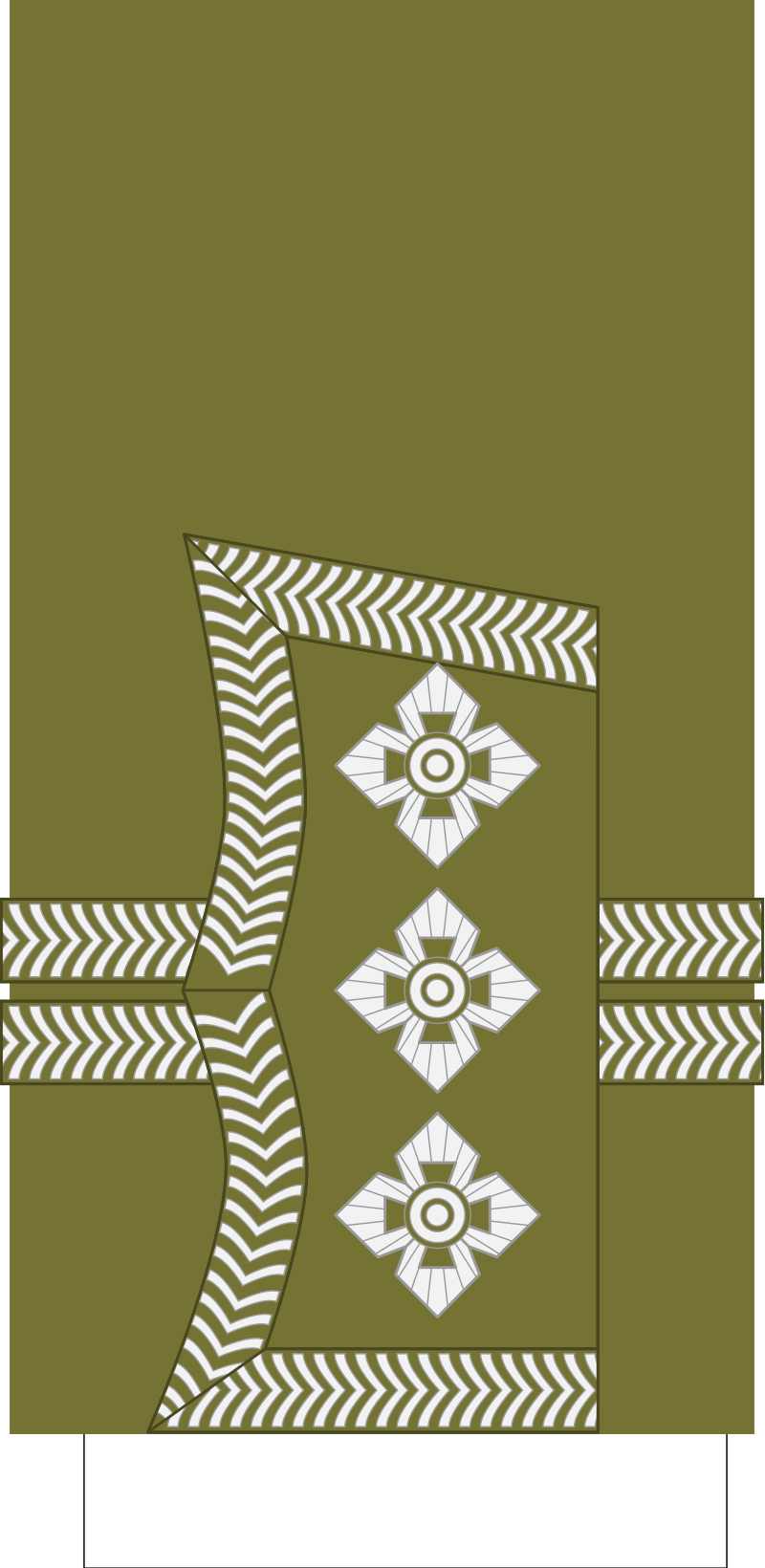
With the outbreak of the Second World War in September 1939, there was a rush to enlist from both the young and old. 57 year old Edgar Copley Adams was no different and in October he was commissioned as a Captain in the 10th Garrison Battalion, a reserve unit of the Australian Military Forces made up of young recruits and veterans of the Great War. CAPT ADAMS was declared unfit for active service but fit for other service and was made a full time officer of the battalion and given command of C Company, of which he was noted as being popular.
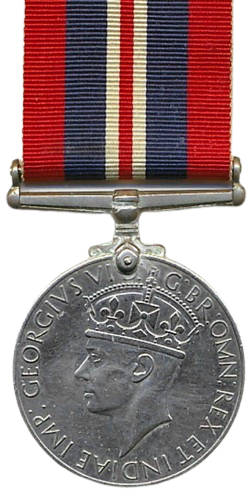
He spent 1940 bouncing between the 10th Garrison Battalion and Western Command where he was a staff officer at the various Recruiting and Reinforcement Depots in Perth, especially at Claremont. CAPT ADAMS spent 1941 at these camps and was sick for an entire month due to Sciatica. CAPT ADAMS was demobilised for a final time in October 1941 due to strength decreases. For his service during the war, he was awarded the War Medal 1939-1945, Australia Service Medal 1939-1945 and the General Service Badge.
He continued to live in Nedlands in the 1940s, moved to Seabrook in the 1950s and finally settled in Northam in the 1960s. He remarried to Hilda Amelia (37 years younger) and together they had three children, Joan, Rex and Roma. Edgar Copley Adams died in Northam in 1968 at the age of 86.
Adams was an Australian soldier who was an expert in close combat, He was physically and mentally tough, compassionate and courageous, He led by example, he strove to take the initiative, He was committed to learning and working for the team, He believed in trust, loyalty and respect for his country, his mates and the Army, The rising sun was his badge of honour, He is an Australian soldier, Always!
Wife (WW1) | Eldest Son - Kenneth Charles Stanley (Applecross WA) (WW2)
Served as a private in the 84th Infantry Regiment in Kalgoorlie during 1910-1911 (Army Reserves). Then served as a Lieutenant instructor for 3 years in the 84th Battalion, Senior Cadets during 1911-1914. Once World War One broke out, he became a Lieutenant in the 84th Infantry Regiment (Army Reserves) in December 1914 where he remained until March 1916.
Wounded in Action on the 25th of May 1918 but remained at duty.
Sick Thrice
Sick with Debility in September 1917 for one week.
Sick with Syphilis in October – December 1917 for two months.
Sick with Sciatica in March – April 1941 for one month.
Mentioned in Despatches, British War Medal, Victory Medal w/ oak leaf device, War Medal 1939-1945, Australia Service Medal 1939-1945, Wound Stripe, Active Service Badge, Two Good Conduct Stripes, Two Long Service Stripes, General Service Badge